

PHOTO
Running a business in regional Victoria has never been a low-cost exercise. Between rising insurance premiums, energy bills that seem to move only in one direction and the ongoing challenge of attracting staff outside the big cities, most operators already feel like they spend half their time managing costs rather than actually serving customers.
Over the past year, another expense has quietly joined the list: the Victorian Emergency Services and Volunteers Fund, also sometimes simply called the ESVF. If the name sounds unfamiliar, that is because many people knew its predecessor much better. The Fire Services Property Levy (FSPL) had been funding Victoria’s fire services for more than a decade, appearing on council rates notices across the state.
In 2025, the Victorian Government replaced that levy with the ESVF, expanding the funding pool to cover a broader range of emergency services, including State Emergency Service volunteers and other disaster response programs.
In theory, the idea is quite straightforward. Regional communities rely heavily on volunteer emergency services, particularly in areas prone to bushfires, floods and storm damage. The new fund is designed to create a more stable source of funding for those services. In practice, though, the change has sparked a fair amount of discussion and debate across country towns because the costs attached to the new levy have increased significantly.
What Changed When the FSPL Became the ESVF
Under the old FSPL system, property owners paid a levy based on the value of their land and property classification. The ESVF follows a similar structure but with expanded funding targets and revised rates.
The difference shows up quickly once people receive their updated council rates notices. Across Victoria, the average residential levy has increased by roughly 29%, while commercial property levies have risen by around 63% on average. For businesses operating on tight margins, particularly in regional areas, that jump is difficult to ignore.
The government has framed the change as necessary to ensure that emergency services have reliable long-term funding. Rural fire brigades, SES volunteers, and other response teams are essential infrastructure across regional Victoria, especially during bushfire season when towns rely heavily on local volunteer networks.
Few business owners dispute the importance of those services. The debate tends to focus more on how the increased funding is being collected and how quickly the costs have risen. This is because government projections show it will raise $1.6 billion in 2025-26, compared to the $600 million–$1 billion collected under the previous FSPL regime.
What This Looks Like in Regional Towns
In larger cities, increased levies can sometimes be absorbed more easily because businesses operate in larger markets. In regional towns, the effect is more immediate.
Take Mansfield as an example. The town has built a strong tourism economy around Lake Eildon, the Victorian High Country, and winter visitors heading toward Mount Buller. That seasonal flow keeps many local businesses up & running. Yet tourism economies also come with fluctuating income.
Summer can be busy, winter weekends bring strong trade, but quieter months still exist. When a fixed property cost increases sharply, it becomes another expense that needs to be managed across the entire year.
A small retail operator in a regional town does not always have the luxury of simply raising prices. Customers are often locals who are feeling the same cost pressures themselves. This creates a familiar challenge for business owners: finding ways to absorb the cost increase without pushing customers away.
The Impact on Commercial Properties
Commercial properties have felt the ESVF increase most strongly because of the larger percentage jump compared to residential rates. Businesses leasing commercial premises may not see the levy directly on their rates notice, yet many landlords pass on these costs through rent adjustments or outgoings.
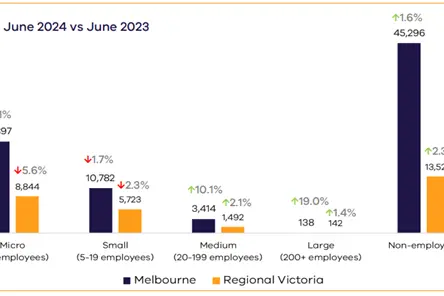
For hospitality venues, retail stores and service providers already balancing wages, energy costs and supply chain pressures, an additional property expense becomes another piece of the financial puzzle. While bigger businesses take the spotlight, the fact of the matter is that micro and small businesses still dominate the numbers in Victoria.
Source: Victoria State Government
It also arrives at a time when many regional businesses are still adjusting to broader economic shifts. Tourism patterns have changed, online shopping has altered retail behaviour, and many operators are still rebuilding after the disruptions of the past few years.
Against that backdrop, even a relatively small levy increase can feel significant.
How Businesses Are Adapting
Regional business owners have always been creative when it comes to managing costs. Unlike larger metropolitan operations, they rarely have the financial bandwidth for large overhead buffers.
One of the most common responses has been tightening purchasing strategies. Retailers are paying closer attention to wholesale pricing, shipping costs and product margins to ensure that inventory decisions make sense financially.
For example, stores that cater to families and tourists often look for ways to maintain attractive price points without reducing product variety. For instance, sourcing wholesale toys in Australia with trusted suppliers can help retailers keep shelves stocked with affordable products while protecting their margins.
This kind of purchasing strategy may sound small in silos, but across a full retail season, it can make a noticeable difference to profitability. When fixed costs rise, the flexibility of inventory management becomes even more valuable.
The Road Ahead
For now, the ESVF is part of the financial juggling for Victorian property owners, and regional businesses are adjusting as they always have: through careful planning, creative sourcing, and a fair amount of practical problem-solving.
Running a business in a regional town has always required adaptability. Weather changes tourist patterns, fuel prices affect supply costs, and economic cycles influence spending habits. The introduction of a new property levy is simply another variable to work around.
If history is any guide, regional Victorian businesses will find a way to make it work, usually with the same combination of resilience, humour and resourcefulness that has kept country towns running for generations.