
PHOTO
IT was in 2018, that Patrick Arundel was looking to buy a small house in Mansfield to renovate.
He would end up purchasing off-market the historic 'Glenroy' homestead, an unlisted property in a state of disrepair, the massive project too large and expensive an undertaking for its then owner.
Living in Merrijig since 1986, Patrick’s father Peter had been admiring the homestead for nearly 40 years.
Peter would ride by it on his dirt bike and one day envisaged owning it.
When Peter and Patrick both heard whispers that the owner wanted to sell, they made an offer and when it was accepted the duo actioned it together.
And so would begin a four year labour of love, as Patrick a carpenter by trade and his father a high-end builder, set about restoring the property to its former glory.
“Personally, I was looking for a little house with a big shed, so I could move all my stuff into the shed,” said Patrick.
“Instead I bought a big house with no shed, and all I do now is garden.”
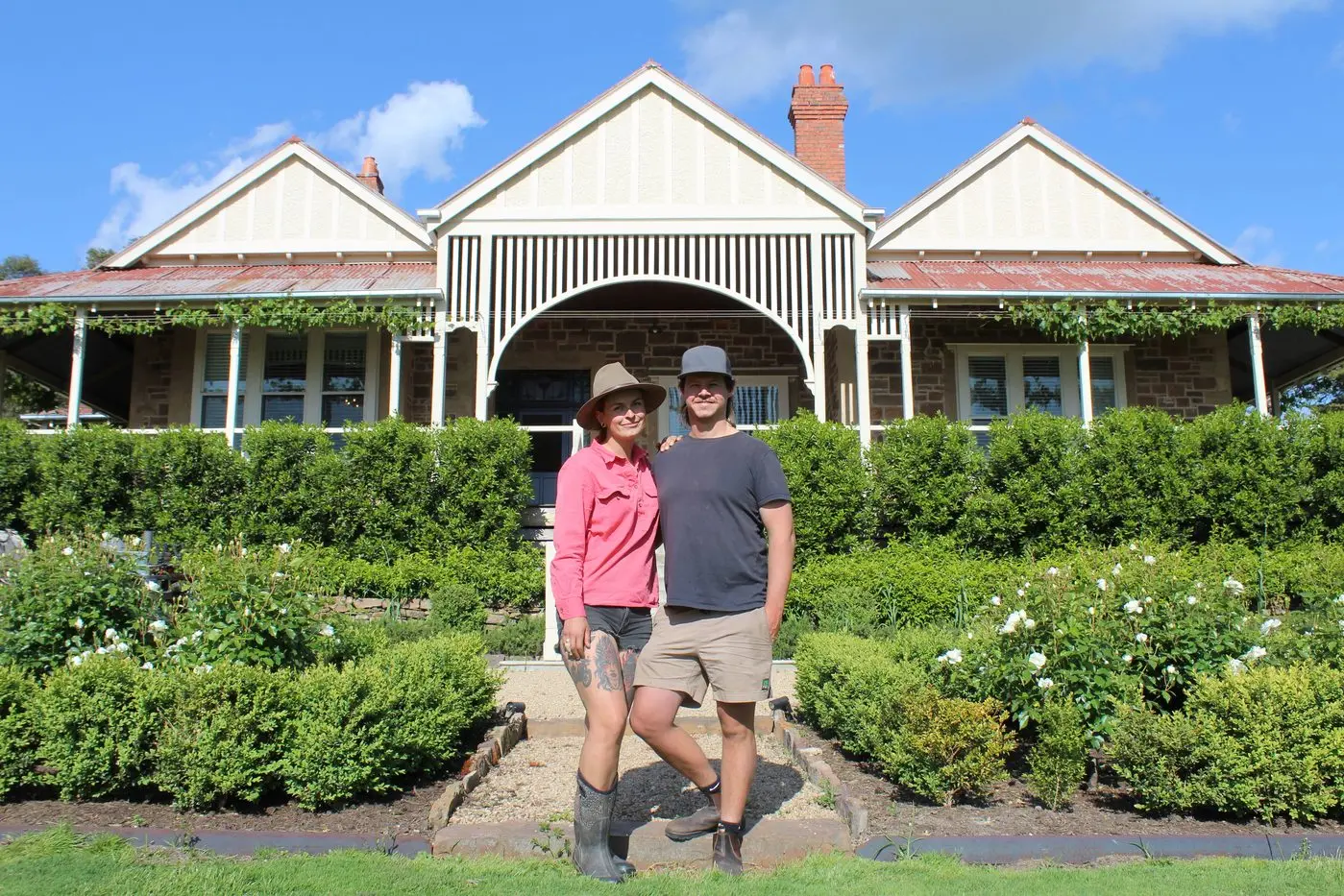
Set on 10 acres of landscaped grounds, renovations of the main homestead are complete and it is now the upkeep of the lawns and garden beds that keep Patrick and his partner Rebecca Sanderson most busy.
It’s a good place to have arrived at, with the homestead looking settled, nestling into its site as the grand home it was always intended to be.
“It was a pretty big task when we first got on-site,” said Patrick.
“There was an 18 month block when we were here non-stop working six days a week.”
However, the father and son took it all in their stride meticulously working their way down the list of tasks that needed to be completed.
This included major earthworks to re-route the driveway and time spent rejuvenating the tired gardens, planting hundreds of plants and hand-building stone walls, creating a veritable park land.
“The stone walls are made from rock offcuts that were scattered around the garden, and when these ran low we would head out into the neighbours’ paddocks picking up stones,” said Patrick.
All the timber balustrades from the front verandah were removed by hand and restored, with any that were unsalvageable painstakingly replaced with exact replicas.
The windows throughout the house were subject to a similar attention to detail, individually removed and repaired as new, taking six weeks in total to complete.
The mudstone walls of the homestead remain true with Pat pointing out the ripple-like patterns across the surface of the rock, captured a millennia ago when the land was the bottom of a lake and the rocks were beginning to form.
The roofing iron is original, with Patrick making it a priority to retain the character of the original structure both inside and out.
“During the renovations we found a whiskey barrel under the floorboards in the lounge room, and the previous owner had uncovered some German machine guns from the second World War,” said Patrick.
“A returning serviceman had brought them back to Australia and the new owner then turned them into the police.
“During our renovations we found plenty of old bottles and a shoe from the 1920s all buried in the grounds surrounding the house.”
Before the lawns were landscaped, the remains of old fencing could also be made out off to the side of the garden, harking back to the 1990s when the property housed a petting zoo, and visitors could come out, see the animals and picnic in the grounds.
The remnants of the original outhouse were hidden amongst the overgrowth in the paddock alongside the house.
The attic in the homestead also remains untouched, the only room that stands still, a snapshot of an era from a time gone by.
Though Patrick and his father have painstakingly restored the homestead, they have also made sure that it features all modern conveniences and comforts.
“The kitchen now expands into what was the maids’ wing, incorporating a laundry and powder room,” said Patrick.
However this is the only interior reconstruction, with the Arundels staying true to the floorplan and retaining that feel of a stately family home.
“We didn’t want to alter the fabric of the building in anyway,” said Patrick.
Alongside the two working fireplaces, there is hydronic heating throughout the house, and the bathrooms have been reimagined with Italian terrazzo in a soft green.
What was originally the school room has been converted into another bedroom, taking the total to five.
The dark timber paneling has been painted white, making the home light and bright, and emphasising the sheer grandeur of the high ceilings and generous proportions of all the rooms and hallways.
“The painters were literally here for months,” said Patrick’s partner Rebecca.
“A lot of the fixtures and fittings were already here, and those that weren’t, I scoured the internet to find,” said Rebecca, who as a qualified electrician embraced the challenge knowing what to look for and where to find it.
“During the renovations I was living in Geelong, and I would spend every weekend coming up to visit, and the time would be spent painting balustrades and stripping back the hinges and the door handles, to their original glory.
Patrick and Rebecca lived in the house for a moment when it was finished, with Rebecca admitting that she felt like she was on holidays all the time, the house so large and grand that the couple decided to realise its potential and open it up as boutique accommodation and a venue for weddings and functions.
Country House Hunters hosted by Catriona Rowntree has featured the renovation as part of the series.
And in recent months, the homestead has played host to another film crew, with scenes from the mystery thriller High Country filmed on location in the grand old home.
Steeped in history, the grand old home looking across the Mansfield valley, surrounded by farmland, is indicative of the region, and the perfect setting for a series on the High Country.
Ann Ware from the Mansfield Historical Society said that Glenroy Station was founded in 1908 as part of the division of the Delatite Station.
“In 1902, Mr Geoff Ritchie, Mr Reg Palmer and Mr Arthur Phillips jointly purchased Delatite Station and in 1908 they divided the land between themselves,” she said.
“Palmer and Phillips took approximately 4390 acres each, with Phillip naming his tract of land ‘Glenroy’.
“In 1909, Phillips commissioned the construction of the homestead, choosing a site with commanding views on the entire Mansfield valley.
“The mudstone home took three years to construct, using stone quarried from a site in the hills behind the homestead, with a team of Italian stonemasons living on site.
“Completed in 1912, the rooms are of grand proportions with the original layout providing maids’ accommodation.
“Phillips would go onto the purchase Palmer’s parcel of land, expanding Glenroy to almost 9,000 acres.
“However after making significant investments in the creation of an impressive station, complete with a 1,200 holding capacity shearing shed, workers cottage and dairy, Arthur Phillips would sell the holding in 1919, leaving the Mansfield area in 1920 and relocating to Deniliquin,” Ann said.
“The new owner was a Mr J Bostock, who was the owner of Preston Station which was north of Mansfield.
“Bostock was a supporter of the soldier settlement scheme providing land to returned servicemen and sold his newly acquired Glenroy land at the lowest price for good quality land sold to the scheme.
“All of this meant that there were 534 acres remaining at Glenroy, surrounding a magnificent homestead.
“It was in 1954 that members of the Crockett family would then buy Glenroy, with the property further divided amongst the family in 2003,” said Ann.
In its current incarnation, Glenroy Homestead sits on 10 acres of garden, with the renovated property a testament to Patrick and Peter, their vision and tenacity.
The Mansfield Historical Society will be hosting an open day at Glenroy Homestead this Saturday November 26, with Patrick and his partner Rebecca generously donating use of the venue for the event.
All funds raised will go towards the fit-out of the yet-to-be-built Mansfield Heritage Museum.