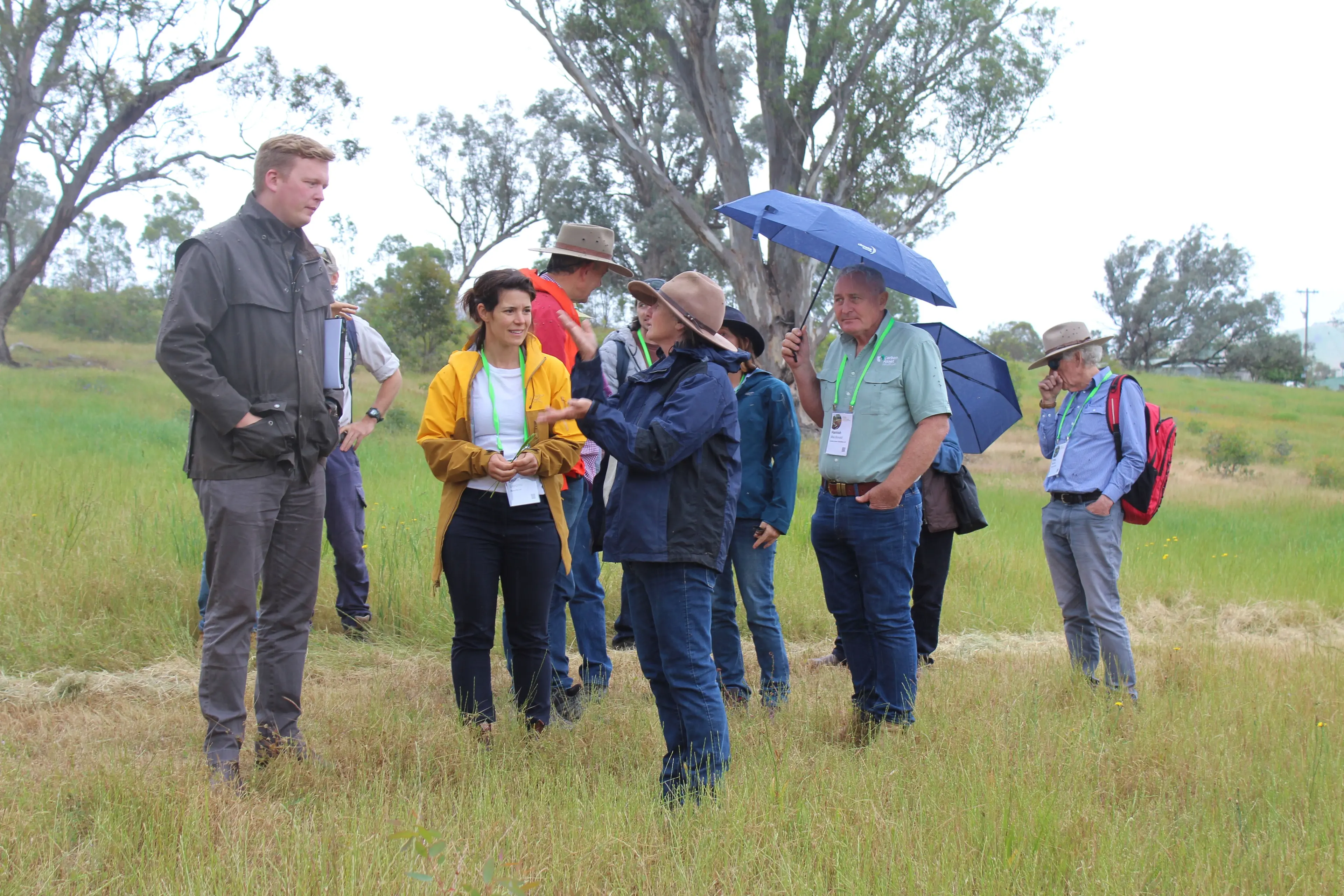
The recent National Carbon Farming Conference and Expo held in Albury brought together agriculture leaders, producers, and innovators from the around the country with a series of guest speakers and panels providing practical strategies and insights for low-emissions farming and opportunities in carbon markets. The four-day event aimed to help farmers turn policy into profitable, practical actions by covering topics like soil carbon, methane reduction, and emissions measurement, and by showcasing what works on the ground. Kickstarting the event, was one such example, with a field trip to Bibbaringa, a 1000-hectare cattle farm near Bowna in New South Wales, demonstrating the move beyond conference theory to the proof in the paddock. Employing regenerative agriculture to actively rebuild the degraded land, property owner Gill Sanbrook has transformed a historically "flogged" landscape into a resilient, productive ecosystem over nearly two decades. In the process she has boosted her business’s resilience, while also sequestering measurable carbon – a core goal of the carbon farming movement. A former rural journalist, Gill purchased Bibbaringa in 2007 during the Millennium Drought. There were 600 cows, 1500 sheep and 90 horses on the property and according to Gill it was severely degraded and overgrazed. And so began a concerted effort to proactively destock with transformation of the landholding enabled by applying the principles of Holistic Management to grazing and landscape renewal. "My purpose is to be prosperous - financially, environmentally and socially - and to produce high quality, nourishing resources to build the natural ecology, with animals and people to sing and work together in harmony," she said. Faced with extreme rainfall variability in what had previously been considered a stable and reliable area for rainfall, Ms Sanbrook developed a disciplined approach to managing stocking rates which involved transitioning her enterprise from cattle breeding to trading and currently agistment. Charting her stocking rate against rainfall, Ms Sanbrook ensures she is ahead of the pendulum "destocking before monthly rainfall declines". Despite being a necessary practice she admits it is still a decision she "loses sleep over". The visible recovery of Bibbaringa - starkly illustrated by a photograph contrasting the 2007 drought landscape with a lush 2022 paddock - is a result of key regenerative strategies. Applying the principles of Peter Andrews - the inventor of Natural Sequence Farming – Ms Sanbrook installed five to six kilometres of contours and "leaky weirs", using earthworks to manage water flow. The goal is to "keep the water as high as possible for as long as possible," slowing the flow to actively rehydrate the landscape. Moving the enterprise to stock on agistment, Ms Sanbrook has nurtured long-standing business relationships with local livestock producers. Her property with its premium grazing is in high demand, however with this comes the understanding that should conditions change de-stocking will occur. Ms Sanbrook employs a short-term, planned rotational grazing system on-farm with stock currently moving through a 90-day plan. This ensures cattle take "one bite everywhere they go", leaving behind a mixed pasture that maintains 100 per cent ground cover, 100 per cent of the time, allowing plants adequate recovery time. Further inspection of the ground cover, highlighted decomposition of litter on the surface, a good sign of the health of the soil and the microbial action. Part of this approach to ground coverage also requires a non-combative view of weeds like thistles and Patterson's Curse, acknowledging the weeds as having a purpose. Alongside these endeavours, Ms Sanbrook has initiated a massive revegetation effort at Bibbaringa supported extensively by the Holbrook Landcare Network. Over 70,000 trees and shrubs have been strategically planted across the property, with efforts concentrating on badly eroded areas and near waterways. Looking back over the process, Ms Sanbrook believes planting more nitrogen-fixing Acacias early in the revegetation journey would have better prepared the soil for the Eucalypts to "spring out". The technical success of management changes is clear not only above the ground but below, in the soil data. Initial tests around 2007 showed organic carbon levels in the top ten centimetres at only one per cent. Through regenerative methods, these levels have since risen to three per cent - or more in some areas - with the increase proving critical when faced with varying rainfall. The higher soil carbon vastly improves the water-holding capacity of the granite soil. The field walk also revealed significant ecological regeneration, with the return of high-successional native grasses like Microlaena and Kangaroo Grass. The field trip was further enhanced by insights from experts, including Dr. Lorraine Gordon and technical specialists like Chris Main and Ben Gosper. Dr Gordon is the Founding Chair of the National Regenerative Agriculture Alliance and Principal of Natural Capital Australia with Climate Friendly and her passion lies in healing farming landscapes and enabling rural communities to thrive. As a regenerative cattle trader and registered carbon farmer at Moffat Falls in Northern NSW, Dr Gordon is committed to reducing greenhouse emissions and assisting farmers navigate the new opportunities around protecting our natural capital. Championing the concept of natural capital—the environmental assets (soil, water, trees) that provide economic and social benefits – Dr Gordon said this accounting approach puts the environment in the context of business resilience. It allows farmers to tell their land stewardship story to financiers and insurers who in turn view improved natural capital as lower business risk. The burgeoning Natural Capital market allows landholders to earn income by improving or protecting their land's natural assets. "If we take care of our natural assets, of course, they'll take care of us," Dr. Gordon said, stressing that improving the environment and production are not mutually exclusive. Dr. Gordon believes there is an urgent need for Australian agriculture to scale up carbon storage. "Farms without trees down the track are going to have a bit of an issue when it comes to balancing this out," she said, highlighting the tree canopy cover's role in a farm’s emissions intensity. Ms Sanbrook who aims to increase her canopy cover from 11 per cent toward the 22 per cent benchmark, affirmed this. "I can't detach trees from production,” she said. Looking to a revegetated paddock, she said the cattle love it. “There's shade, there's water, there's grasses, and if I can get the whole place looking like that, that would be really fantastic.” Cootamundra cattle grazier, head of Climate Friendly’s soil projects and co-founder of Australian Soil Management, Chris Main, is working in collaboration with Dr Gordon, and added to the discussion on the specifics of soil carbon. Climate Friendly is one of Australia's oldest carbon farming companies, working on over 200 projects nationwide. The company has been involved in issuing over 25 million carbon credit years (indicative of the industry's maturity) and this experience is now being applied to the natural capital market, by developing a Natural Capital Standard for Australia. Ben Gosper then connected farm health and natural capital to building soil carbon. Managing Director at Draiger Pty Ltd, the company specialises in soil carbon sampling, remediation, and custom monitoring systems, supporting regenerative agriculture and sustainability goals across Australia. Mr Gosper said improving soil health can directly boost the bottom line for many farmers. Increasing carbon stock within the ground means building the soil infrastructure - the deep root systems and microbial life – which in turn supports a larger, more stable flow of carbon. Using an analogy that generated some light ribbing from attendees at the field day, Mr Gosper said improved soil is like upgrading from a "Datsun to a Rolls Royce," allowing the same amount of rain to take you "a lot further, a lot nicer, and a lot faster". “Healthier soils improve productivity, reduce input costs, and increase resilience to challenging conditions, helping farms operate more efficiently and profitably,” he said. And then beyond these operational benefits, there are also grants and incentives available to support the adoption of regenerative practices. “Soil carbon projects are another opportunity; by increasing the carbon stored in your soil, farms can generate revenue through carbon credits, creating an additional income stream,” he said. Beyond the financial incentives, Ms Sanbrook spoke to the benefits of being able to access soil data for her own mental wellbeing and business direction. "It is unbelievable how it's empowered me and given me a new sense of understanding,” she said. “It’s an invaluable document to where I’m stepping." Ms Sanbrook emphasised that regenerative success isn't about rigid rules, rather it is about observation and adjustment. Her long-term vision looks beyond the financial year, trusting in natural processes. The shift in financial perspective required for regenerative farming, means that Ms Sanbrook embraces a longer-term mindset instead of focusing solely on the "12-month period from July to June". "I try to look over a period of time that I'm making money in the long run," she said. “Then I factor in the financial gain that I'm going to get from the environment. “I'm actually building a brand." This long-term perspective also dictates her management choices, such as her decision to allow the land to heal naturally rather than use inputs like lime to quickly correct mineral deficiencies. Observing lime being blown away by wind on neighbouring properties solidified her preference for nature's pace. "I’m happy that the plants and succession will possibly do it all anyway,” she said. “I’m here for the longer walk." This long-term commitment aims for a non-quantifiable, emotional goal of creating a property that is in "harmony". Gill summed up this aspirational shift in farming, as wanting Bibbaringa to “hum”. “I invite people onto this property, and I want them to feel that,” she said. “I want them to go away and know that the food that is coming from this property is going to emulate that energy throughout." Regenerative farming is not just a suite of practices - it’s a holistic, long-term approach where ecological health and financial prosperity are inextricably linked, resulting in a landscape that as Ms Sanbrook said “literally starts to hum".