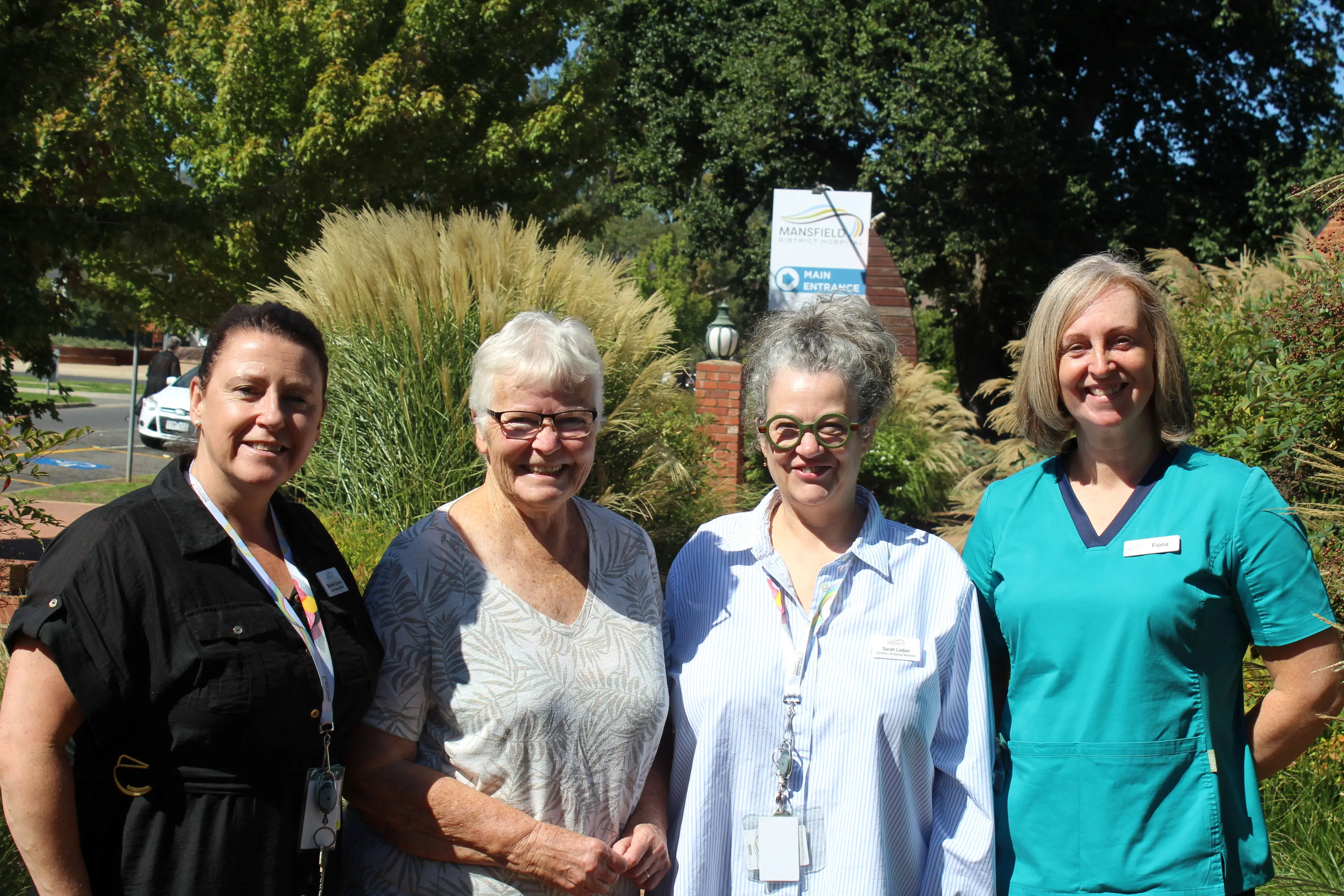
In a significant boost for local healthcare, Mansfield District Hospital (MDH) is set to expand its medical imaging department with the arrival of a DEXA bone density scanner. This $98,000 investment—funded entirely by the Mansfield Hospital Auxiliary—marks a major milestone in providing specialised care close to home, closing the gap between rural and metropolitan health services. For many in the community, particularly the ageing population and those with chronic conditions, this means the end of a long wait. Currently, patients requiring a bone density scan often face a 12-week wait list in Wangaratta or are forced to travel long distances. Radiographer team lead Fiona Creighton identified the need for the service, which was further reinforced by local general practitioners after consultation with the hospital. "Many people were either delaying these vital scans because they didn't want to travel, or they were simply missing out,” said Michelle Spence, CEO of Mansfield District Hospital. “When we reached out to the Auxiliary, their response was immediate and they made it happen.” The new equipment offers more than just standard osteoporosis screening, with the machine capable of monitoring bone loss associated with a range of chronic conditions such as liver or renal disease. The state-of-the-art technology also includes fracture risk assessment—providing patients in their 50s with proactive data to begin weight-bearing exercises and strengthening protocols decades before a potential fall—along with body composition scanning, a tool for athletes and those managing weight that measures precise bone, muscle and fat composition. Another positive is the equipment uses a low dose of radiation to measure bone density, equivalent to less than a single day’s worth of natural background radiation. "This is about preventative health and health promotion," said Ms Spence. "While we often focus on acute emergencies, this allows us to look at the bigger picture of our community's future wellbeing." The purchase is the latest in a string of high-impact contributions from the Mansfield Hospital Auxiliary, which has been supporting the hospital for more than 102 years. Unlike many hospital auxiliaries that focus on smaller amenities, the Mansfield group tackles "big ticket" items that would otherwise be difficult in the current fiscal climate. In the last three years alone, the auxiliary’s fundraising has transformed the hospital’s capabilities. The hospital’s imaging department is now almost entirely "new", with all major equipment replaced within the past three years. This modernisation includes a new ultrasound machine, advanced X-ray capabilities and lymphoedema scanning, along with other hospital upgrades such as state-of-the-art dialysis chairs. Supported by a $60,000 specialist X-ray plate donated by the auxiliary, the hospital can now perform high-resolution imaging for neonatal babies—a service previously unavailable locally. A $9,000 lymphoedema scanner was also purchased in recent years to assist cancer and chemotherapy patients, providing vital monitoring for those at risk of chronic swelling. And $27,000 was invested in dialysis chairs, allowing the Mansfield District Hospital and Royal Melbourne Hospital-run program to operate at a higher capacity, with the old chairs repurposed for shorter infusions, freeing up space for critical long-term patients. Val Doyle, of the Mansfield Hospital Auxiliary, credits the community's generosity for these successes. "Our recent Charity Golf Day raised between $40,000 and $50,000, and our Melbourne Cup weekend Art Show brought in $18,000. “The local businesses and residents all recognise the value of our hospital, and they all show up and generously support it." The impact of this equipment extends beyond patient care; it is also a vital tool for staff retention. "When you have state-of-the-art equipment that matches the high skill set of our staff, you attract and keep the best people," Val Doyle said. "It’s why we see staff here receiving 30 and 40-year service awards. “They have the tools they need to do their jobs at a high level." In addition to the new equipment, the hospital is also proactively expanding its ultrasound services. “Wait times for diagnostic imaging can be a source of significant anxiety for patients,” said Ms Spence. Recognising this, MDH has expanded access, with services nearly doubled, moving from four days a fortnight to seven days a fortnight. “This expansion has slashed wait times from six-to-eight weeks down to just two-to-three weeks,” she said. “The hospital has also carved out dedicated emergency slots every week. “If a local GP deems an ultrasound urgent, it gets done immediately, ensuring critical diagnoses aren't delayed by the calendar.” While these expanded services necessitated a shift from free, bulk-billed ultrasounds to a paid model to cover increased specialist staffing costs, CEO Michelle Spence emphasises that affordability remains the priority. "In the current economic climate, we need to break even to keep these services viable," Michelle said. "We’ve kept our costs as low as possible—significantly lower than other facilities—to ensure we meet local demand without compromising on quality. “And for those on low-income benefits and healthcare cards the service remains free,” she said. The hospital’s ongoing expansion would not be possible without the input of local practitioners highlighting community needs, with the Mansfield Hospital Auxiliary enabling the hospital to deliver these services. "If we didn't have the support of the auxiliary, these improvements would be stuck in deliberation for years," said Michelle Spence. "Instead, I can send an email one day, and they make it happen the next. “It’s a relationship built on deep trust and a shared commitment to our community." By investing in the latest technology, MDH is not just treating illness—it is attracting and retaining top-tier medical staff who want to work with the best tools available. From the Art Show to the annual Golf Day, every dollar raised by the community is being funnelled directly back into the machines that support local healthcare.