
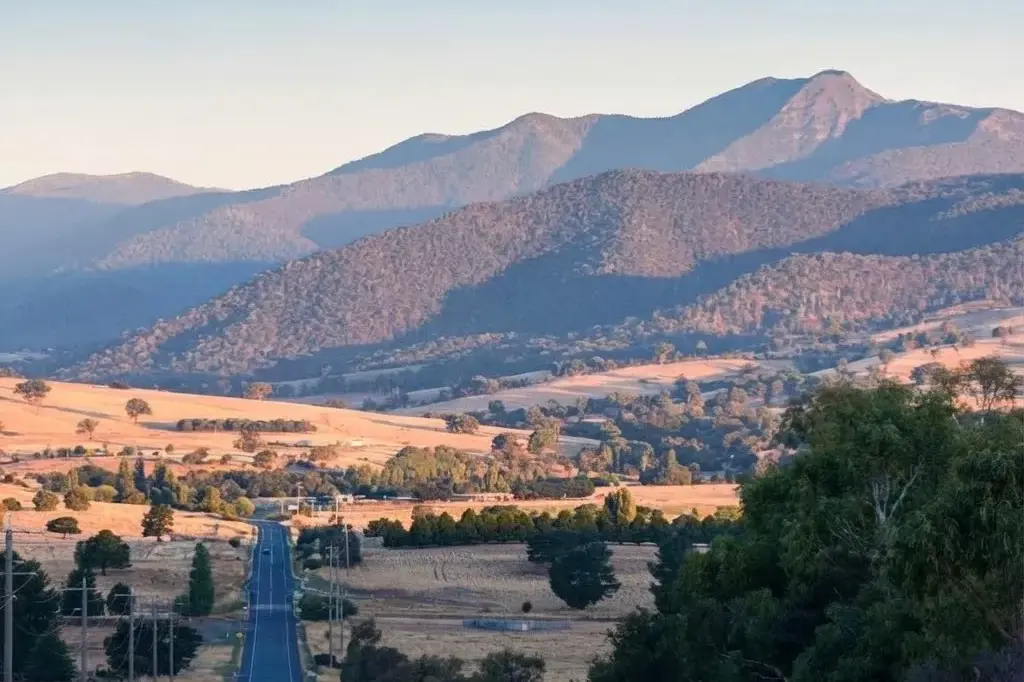
PHOTO
In a clear decision for the Glenroy Road community, the Mansfield Shire Council voted unanimously on 17 December to refuse a planning permit for a stone extraction operation at 131 Terry Road.
The decision followed nine deputations from local residents and business owners who argued that the “rock rush” currently facing the shire threatened the amenity of the region and the “sacrosanct” Alpine Approach.
The applicant then addressed the chamber, seeking to rebut community concerns.
Councillors deliberated before refusing the application on eight grounds, citing issues ranging from “significant deficiencies” in noise and dust assessments to the permanent scarring of land within the Significant Landscape Overlay Schedule One (SLO1).
DR WILL TWYCROSS
Dr Will Twycross led the deputations, noting that the SLO1 protections were introduced in the 1980s and were specific to Mansfield Shire.
“Often in planning people don’t consider views,” he said.
“But views are actually enshrined in the overlay, and those are views from roads, public viewpoints and private land, and there are rights associated with this.
“So it’s not just about the views from Mt Buller Road and the Alpine Approach, it’s about the whole overlay and it’s also about amenity of the land.”
Dr Twycross responded to comments from the applicant and the consulting engineer suggesting objections were “ideological”.
“If that was meant to be a slight, I take it as a compliment because an ideology is a firmly held belief rooted in science and history,” Dr Twycross said.
JASON TRANTER
Jason Tranter then addressed the chamber, presenting visual material using Google Earth mapping to challenge claims the quarry would be hidden from view.
“It is clearly visible for 3.4 kilometres of Mount Buller Road,” Mr Tranter said, indicating the site would be visible to residents and visitors.
He said the quarry would also be within line of sight of landholders on both Ingomar and Glenroy roads.
Concerns about the impact on the local economy — particularly the relationship between farming and agritourism — were also raised by other objectors.
NIKKI DUCLOS
Nikki Duclos, representing her fiancé Bear Hodge’s family farm held by the family since 1908, spoke of the potential impact on their purpose-built tourist accommodation.
She said the farm boundary sits just 60 metres from the proposed quarry, with the haulage route running alongside the property.
“For 46 years, our farm has hosted tourists and supported the community by lodging essential regional workers such as vets, teachers and seasonal staff,” Ms Duclos said.
She told council the properties along Glenroy Road played an important role in tourism, community life and the identity of the region, and urged councillors not to approve the proposal.
“Let us not sacrifice the long-term prosperity of farms that have put our community on the map for the short-term gain of an industrial venture with minimal community benefit,” she said.
JAMES SHAW
James Shaw, a sixth-generation farmer and livestock transporter, raised concerns about the impact of heavy vehicles on local roads, disputing suggestions that industrial trucks were comparable to farm vehicles.
He said while his family business’s livestock trucks often travel empty, loaded rock trucks weighing significantly more would place “significantly more strain” on sheet gravel roads.
“Of equal importance, our livestock trucks only travel alongside our own property on Glenroy Road and do not pass any other residential properties,” Mr Shaw said.
“We choose not to use Ingomar Road due to its condition and the access point to Mt Buller Road, which we deem — as experienced truck drivers — to be unsafe.
“Also contrary to the applicant’s statement, the rock haulage trucks will pass directly past four residential homes, affecting them with dust and noise pollution.”
KYM LYNCH
Kym Lynch drew on her experience with the Merrijig Residents Action Group, citing a 2018 VCAT decision at Buttercup Road where council refused a similar quarry application and the tribunal upheld the ruling.
Quoting from the decision, she said the proposal was found to have “unacceptable amenity and landscape impacts” that would diminish the area’s highly valued landscape qualities.
She told council the Terry Road proposal sat within the same Significant Landscape Overlay, formed part of the same designated Alpine Approach and was subject to the same planning controls.
“Local government policies emphasise the importance of agriculture and tourism for the economic prosperity of the shire,” Ms Lynch said.
“There is no reference to stone extractive industries.”
She warned of a “proliferation” of quarry applications, describing them as “selfish wishes of landholders seeking profit over views”.
“This is the third quarry proposal in the Significant Landscape Overlay Schedule One, and they’re all within a stone’s throw of each other,” she said.
Ms Lynch also questioned what she described as “poor and unsubstantiated claims” in the application, including the lack of detailed geotechnical analysis.
SARAH STEGLEY
Sarah Stegley described the surge in applications as part of a “gold rush” for mudstone, referring to it as a “rock rush”.
She opposed the proposal, saying it would “scar the landscape, silt the waterways, [and] use heavy duty extraction equipment in a rural paddock” within the “sacrosanct” Alpine Approach.
“This permit application to attempt to rock mine within an Alpine Approach is a costly waste of money and time for all parties involved,” Ms Stegley said, noting the 40 years of community work that went into gazetting the SLO1 protections.
She described the existing protections as one of the shire’s “greatest endeavours”.
JEREMY MADIN
Jeremy Madin, president of Delatite Landcare, described claims that rock extraction amounted to “land rehabilitation” as “disingenuous”.
He said removing rock compromised the land’s ability to retain moisture and minerals.
“Removing rock to several metres depth and backfilling with saved topsoil and imported soil must be the world’s most expensive land rehabilitation project, particularly as it is improving the pasture at great expense on just a tiny proportion of the applicant’s land,” Mr Madin said.
“The moment you start pulling rocks out, you also ruin the lie of the land.
“The sale of mudstone as a landscaping product is clearly the purpose of the application.”
Mr Madin questioned claims in the application that “the viability of the land for agricultural needs will serve the region for generations to come”.
He also raised concerns about what he described as inconsistencies regarding the depth of cuts and methods of backfilling, saying “significant scarring and possibly erosion will remain after rock extraction on this steep country”.
GUY ELLIOT
Guy Elliot raised concerns about potential noise impacts, saying noise levels could increase from 32 decibels to more than 60.
“The noise we are talking about does not include just the excavators and the hammering, but also loading heavy rocks into trucks and dogs, movement of trucks to and from the site, along with all the ancillary equipment like graders, front-end loaders, water trucks and so on,” he said.
“Nor has the applicant made any attempt to assess or offer any reduction strategies to limit the noise apart from limiting hammering to two days per week.
“The bottom line is we don’t want hammering any day of the week,” Mr Elliot said.
JAMES HOOK
James Hook spoke about the Glenroy Road community and Mansfield more broadly, calling on council as “our elected representatives…to safeguard our interests and aspirations”.
“The proposal for a quarry near Glenroy Road has virtually no quantifiable benefit to the community,” he said.
“You can’t just take from a community and expect that community to survive.”
He said the proposal suggested two local jobs may be created, but that these would only be for six months of the year, and noted the proponent had stated they had no history in the stone extraction industry.
“If there is an ideology in the High Country it’s that of independence — whether we were born in the shire or choose to move here to enjoy the peace, tranquillity and natural beauty of this wonderful part of Victoria,” Mr Hook said.
PETER ARVANITIS
The final deputation to council was from the applicant, Peter Arvanitis, who described community concerns about the Alpine Approach as a “kerfuffle”.
He said the site was not visible from Mount Buller Road, disputing objectors’ claims about the visibility of the proposed quarry, and reiterated that the proposal was for a “permitted use” intended to improve his land.
“The site is four kilometres from the highway, and to suggest this practice will have an impact on tourism is drawing a long bow,” Mr Arvanitis said.
“I wonder about other mudstone extraction sites in the shire and what impact they have actually had on tourism.
“I believe none.”
He asked councillors to consider standard agricultural activities, questioning whether farming practices such as grazing, resowing, hay and silage cutting, or fencing rehabilitation should also be restricted due to visual impact.
“There is a lot of equipment required for these activities.
“Not so with rock extraction — just an excavator and a truck,” he said.
Mr Arvanitis also downplayed the impact of the proposed haulage route, suggesting slow-moving trucks would generate “insignificant” dust compared to standard vehicles.
He said trucks would travel at a maximum speed of 25km/h and assured council he would install a “noise decibel metre” to ensure compliance with EPA guidelines.
Mr Arvanitis said he was disappointed no objectors had accepted his invitation to visit the site, citing a “lack of spirit and good faith” and questioning the genuineness of their concerns.
“I think it’s almost unconstitutional — un-Australian even — to restrict a man from earning a living from the land when he is doing no harm and making a contribution to the shire,” he said.
The proposal then went to councillors for discussion, with the planning department recommending the application not be approved.
Councillor Bonnie Clark moved to refuse the application, with Councillor Mandy Treasure seconding the motion.
“If we’re going to have a significant landscape overlay and Alpine Approach, we have to be consistent,” Cr Treasure said.
Citing issues including a lack of information on noise, dust and geotechnical assessments, along with concerns about visual impact, erosion and water quality within a catchment area, the motion was carried unanimously.
Cr Tehan emphasised the importance of the overlay and said the site could be seen from Mt Buller Road.
“It would be a real travesty of justice if anyone was to defy the SLO in this instance,” he said.
“It could have pretty devastating effects on a lot of members of our community.”
The public gallery, filled with Glenroy Road residents, welcomed the decision, a sentiment echoed by objector James Hook, who said the community “unites with a common voice when these values are challenged”.